


UK Student Visa
UK Student Visa “How-To”: Step-by-Step Application + Refusal-Proof Checklists
UK visa refusals are rarely about “not being eligible.” Most refusals happen because one small rule wasn’t followed, a document was missing, or a detail didn’t match across the form, CAS, and supporting evidence.
This guide is designed to help you apply cleanly the first time. You’ll get:
- A clear, practical UK Student visa application process
- A master UK Student visa document checklist
- Proof of funds explained in plain English (UK-specific)
- The top refusal reasons and exactly how to avoid them
If you’re aiming for a smooth, stress-free submission, this is your roadmap.
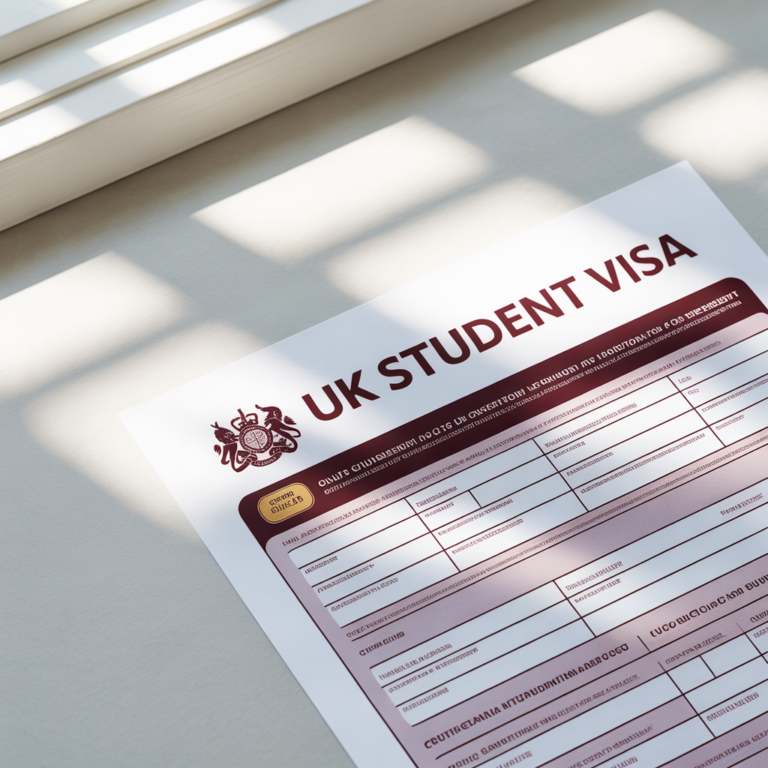
What UKVI checks in a Student visa application
When the UK reviews a Student visa, the decision is built around a few core questions:
- Have you been accepted by an approved UK institution?
This is proven by your CAS (Confirmation of Acceptance for Studies). - Do you have enough money for tuition + living costs?
This is where most mistakes happen: the amount, the timing, and what funds are acceptable. - Do you meet the English requirement (if applicable)?
This depends on your course level and how your university confirms your English ability. - Have you met any additional requirements?
Examples include TB testing for certain countries and ATAS for certain subjects/nationalities. - Are you a genuine student?
UKVI may assess credibility based on your application details and sometimes an interview.



UK Student visa step-by-step (from CAS to decision)
Step 1: Get your CAS — then verify every line
Your CAS is not a generic letter. It contains details UKVI will rely on: course name, dates, tuition fees, and sometimes any payments already made.
Refusal-proof tip: Treat your CAS like a legal document. Check:
- Spelling of your name (exactly as passport)
- Passport number (if shown)
- Course title and level
- Start and end dates
- Tuition fee amount
- Any fee deposit already paid (this affects your money calculation)
If anything is wrong, ask your university to correct it before you apply.
Step 2: Calculate funds properly (tuition + living costs)
Your money requirement is usually:
Total funds = tuition fees (as stated on CAS) + living costs (maintenance)
The living cost amount depends on whether your course location is in London or outside London, and is calculated up to a maximum of 9 months.
Refusal-proof tip: Don’t guess the city category. Confirm whether your campus is treated as London for visa maintenance purposes.
Step 3: Prepare your documents before you start the online form
Many applicants begin the form first—and only then scramble for the documents. That’s risky.
Instead, build your folder first. You want:
- All documents ready to upload
- Dates aligned (especially bank statement dates)
- Names consistent across passport, bank accounts, and letters
This prevents last-minute “fixes” that accidentally break rules (like topping up funds too late).
Step 4: Apply online + pay fees (visa fee and healthcare)
During the online application you’ll pay:
- The visa application fee
- The Immigration Health Surcharge (IHS) (the NHS healthcare fee)
Save receipts and confirmation pages for your records.
Step 5: Prove identity (app or visa centre) and upload documents
Depending on your nationality and location, you may:
- Use a digital ID verification route, or
- Visit a visa application centre for biometrics (fingerprints + photo)
Follow the instructions shown in your application portal for document upload and appointment steps.
Step 6: Wait for a decision (and be ready for verification)
Some applications are decided quickly. Others take longer if UKVI requests:
- Extra documents
- Verification of financial evidence
- An interview or credibility check
Refusal-proof tip: Keep your phone and email responsive during this period. Missing a request can cause delays or refusal.
Step 7: After approval — plan travel and arrival
Once approved, you’ll receive digital status (eVisa) or entry clearance details depending on the process used. Plan:
- Arrival date window
- Accommodation and airport pickup (if available)
- Your university registration and orientation timeline
UK Student visa document checklist (master list)
Use this as your master submission checklist. Not everyone needs every document—but most refusals happen when applicants assume something is “optional” when it isn’t.
A) Core documents (almost always required)
- Valid passport / travel document
- CAS number and CAS details from your university
B) Financial documents (required if you must show funds)
- Bank statements or bank letter (correct format and dates)
- Evidence of tuition fee payment already made (if any)
- Student loan letter (if using a loan)
- Sponsor letter (if sponsored)
- Parental funds evidence (if using parent’s account) + relationship evidence
C) Academic / English evidence (when required)
- English test result (if required for your route)
- Qualification certificates/transcripts (only if your CAS/route requires you to provide them)
D) TB certificate (only if required)
- TB test certificate from an approved clinic (if applicable based on residency history)
E) ATAS certificate (only if required)
- ATAS clearance certificate (if your course requires it)
F) Translations (commonly missed)
- Certified translations for any document not in English (or Welsh)
G) Under-18 documents (if applicable)
- Parent/guardian consent letter
- Proof of relationship (e.g., birth certificate)
- Care and living arrangement details
Proof of funds (UK Student visa): what counts, what doesn’t, and the “28-day trap”
If you only read one section, read this.
What “proof of funds” really means
UKVI isn’t asking whether you can pay. They’re asking whether the money:
- Is in an acceptable form
- Is available to you
- Has been held for the required period
- Meets the exact amount required
One missing detail can trigger refusal.
The 28-day rule (where most applicants get caught)
A common refusal pattern looks like this:
- The applicant tops up the account to reach the required amount
- They apply immediately afterward
- UKVI refuses because the funds weren’t held long enough
Refusal-proof rule of thumb:
If you need to show bank funds, keep the required balance untouched for the full required holding period before applying.
Also watch the statement date window. Statements must be recent and fall within the acceptable timing relative to your application date.
Acceptable money sources (typical)
Depending on your situation, acceptable sources can include:
- Personal savings
- Parent’s savings (with relationship evidence and permission)
- Official financial sponsorship (government, university, international organisation)
- Student loan that meets UKVI formatting requirements
- Partner’s funds (only in certain circumstances)
Refusal-proof tip: If you’re using someone else’s account (parent/partner), include the correct consent wording and proof of relationship. Don’t assume a generic “support letter” is enough.
Funds that usually do NOT count
Avoid relying on funds that UKVI doesn’t accept for maintenance, such as:
- Overdraft facilities
- Credit cards
- Crypto holdings
- Shares/stocks portfolios
- Pension pots
If your financial plan depends on one of these, convert it into an acceptable form early, then hold it correctly.
Common UK Student visa refusal reasons (and fixes)
Here are the refusal drivers that show up again and again—plus what to do instead.
1) Wrong financial amount (tuition + living costs miscalculated)
What goes wrong: Applicants show maintenance only, forget tuition, or misunderstand London vs non-London living costs.
Fix: Build the total from your CAS tuition + correct living cost category. Double-check deposits already paid and reflected in your CAS.
2) Funds not held correctly (the “28-day trap”)
What goes wrong: Statements show the right amount, but not held continuously for the required period, or statements are out of date.
Fix: Plan your timeline. Keep the funds steady and produce the correct statement/letter at the right time.
3) Unacceptable bank statements or missing bank details
What goes wrong: Statement doesn’t show required details (account holder name, account number, bank name/logo, dates, balance history).
Fix: Request a compliant bank letter/statement from your bank. Digital statements may be acceptable if they include all required details—avoid screenshots.
4) Missing sponsor consent (where applicable)
What goes wrong: Applicants previously had official sponsorship and submit no sponsor consent.
Fix: Obtain a clear sponsor consent letter that explicitly allows you to study in the UK and confirms funding (or confirms they have no objection).
5) Missing TB or ATAS (when required)
What goes wrong: Applicant overlooks a requirement triggered by nationality/residency history (TB) or course subject area (ATAS).
Fix: Confirm early with your university and official guidance whether TB/ATAS applies. Book TB tests early and apply for ATAS as soon as eligible.
6) Credibility issues (Genuine Student concerns)
What goes wrong: Your story doesn’t make sense to a caseworker:
- The course choice doesn’t match your background
- Study gaps aren’t explained
- Funding plan is vague or inconsistent
- You can’t clearly explain why the UK, why this course, why now
Fix: Prepare a simple, consistent narrative:
- Why you chose the course and university
- How it supports your academic/career pathway
- How your tuition and living costs are funded (with evidence)
- What your realistic plan is after your studies
Keep it honest, specific, and consistent across documents and any interview.
Refusal-proof micro-checklists
Checklist 1: Bank statement “pass” checklist
- Account holder name matches your passport (or matches parent + relationship evidence)
- Bank name and account number are visible
- Statement covers the required holding period
- Balance never dips below the required amount during the holding period
- Statement date is within the acceptable window before application
- Currency conversion is clear (if not GBP)
Checklist 2: Sponsor/loan “pass” checklist
- Letter is on official letterhead
- Dated and signed (or digitally verifiable)
- States the amount and what it covers (tuition/living)
- Names you clearly and matches passport spelling
- Includes contact details for verification
Checklist 3: Final “submit day” audit (15 minutes)
- CAS details match your form answers exactly
- Tuition + living costs calculated correctly
- Financial documents meet timing rules
- Translations included for non-English docs
- TB/ATAS included if required
- All uploads are readable and complete (no cut-off pages)
Final advice: apply like a caseworker is reading it (because one is)
- Cross-check your CAS against your application answers
- Validate your proof-of-funds calculation and financial evidence
- Run a refusal-risk scan using the checklists above
- A careful review before submission can save months of delay, extra fees, and unnecessary stress.